The journey of Amarnie Solomon Edwards, a Hidden Genius Alum from our inaugural Baltimore Cohort (BAL1), was sparked by his interaction with our Hidden Genius Alumni. He was first introduced to The Hidden Genius Project at one of our Catalyst events, where Amarnie quickly found a sense of belonging within our brotherhood of Alumni Youth Educators. Through our Intensive Immersion program, he developed a passion for game development and coding. Now a junior in high school, Amarnie is exploring future pathways in mechanical engineering, aerospace, and aviation, and recently returned to support our Brothers Code event in Baltimore as a Youth Educator himself.
How have you been? (With life? With Family? With school? Work?)
You know, I’ve been okay! Lately, I’ve been preoccupied with school and this paid internship called Parks and People. The internship is really fun, getting a more in-depth idea of how our environment operates. Honestly, I’m just trying to stay focused and figure out what I truly want to do with my life, since this is my junior year of high school. School has been pretty tough for me, though, with all these assignments I need to complete. But other than that, things have been great.
How did you first learn about The Hidden Genius Project?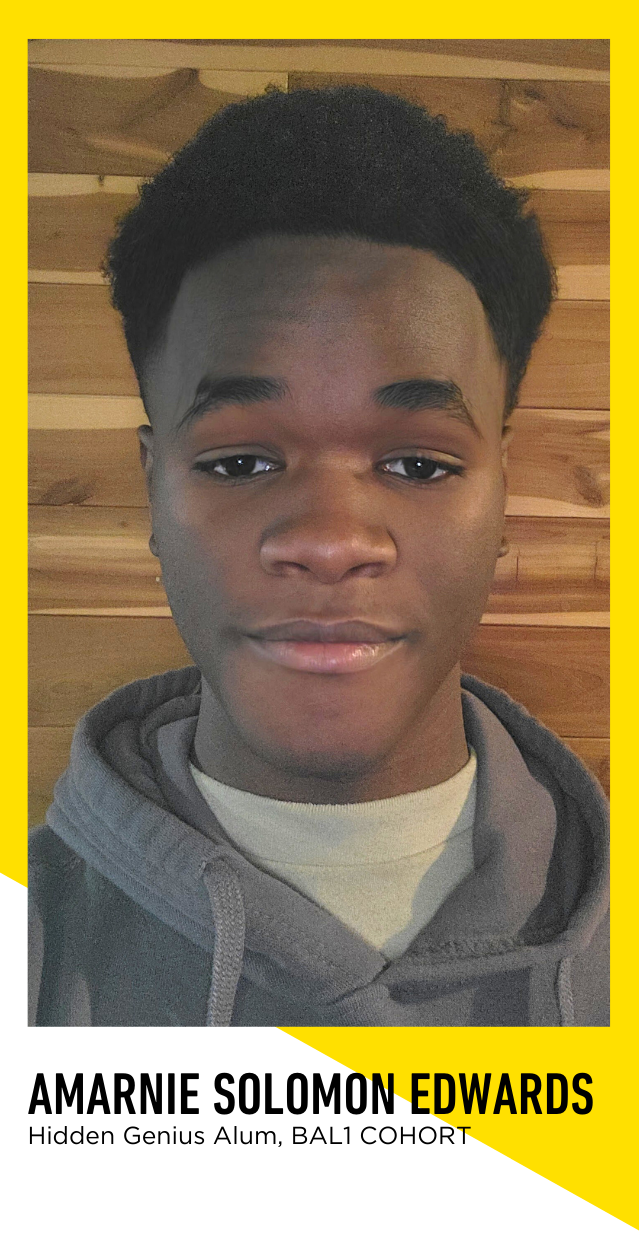
If I’m being honest, I didn’t find The Hidden Genius Project on my own, and I didn’t want to join when I heard about it. My mom heard about one of the local catalyst events being hosted at Coppin State University called “Tech Slam Baltimore”. At that time, I was pretty lazy and didn’t want to attend the event. But my mom made me go anyway. After joining The Hidden Genius Project, my whole perspective on the program changed. It was very interactive and engaging, with [Site Director] Ms. Cydni’s energetic vibe and the hands-on activities and lessons that were taught by the Youth Educators.
What was your experience in the program like (with Leadership, Entrepreneurship, and/or Technology)? What did you enjoy? Program highlights?
In the first summer, it was very challenging and overwhelming when it came to learning the new information. There were twenty-four geniuses, including myself and one Innovation Educator at the start, so naturally, it got crazy real fast. As we went through the rest of the program, I started comprehending the information, and gradually began to enjoy hanging out with the other Geniuses. One of the core highlights of the program for me was the moments I got to spend with my brothers. We would host gaming fun tournaments to bond in our free time, and almost the entire cohort would participate.
Describe the final project you created during your time in the Immersion Program.
The final project that I created was a 3D platformer puzzle/survival game. The player is an astronaut who crashlands on an alien planet called Oxeris. Their goal is to collect different parts for their broken spacecraft so they can leave. The only way for them to collect those parts is by completing several dangerous puzzles. Once they are done, they will be able to leave the planet. I created this game during programming, but I am actually still working on it and trying to make it better. One of the things I am doing to make the game better is adding 3D models from Blender. I am learning how to use the software so I can incorporate my own designs.
How is The Hidden Genius Project different from other mentorship or training experiences that you have been involved in?
Programs like The Hidden Genius Project maintain a certain level of professionalism in their interactions with the participants. In these similar programs I’ve been in, the people who run them never really made an effort to get to know their participants on a personal level. While The Hidden Genius Project is still a professional setting, they make sure your thoughts and feelings are heard and validated. This created a different and better experience for me.
What specific skills learned in The Hidden Genius Project have been most beneficial for you?
The skill that has been most beneficial to me is game development. The Hidden Genius Project didn’t just teach me how to code in C#; the Innovation Educators taught me how to think creatively. Having the ability to think outside the box opened my mind to new ideas and new ways to solve problems. Instead of getting stuck or giving up, I learned how to break things down, try different approaches, and actually enjoy the process of figuring things out.
What was the most important thing you gained on a personal level from participating in The Hidden Genius Project?
I consider myself an introvert, and I don’t like talking to people. Because of this, a challenge I faced was communicating with others. At the start of the Immersion program, I had a bad habit of distancing myself from my brothers and not really talking to them. I didn’t have much self-confidence in what I was saying, and I felt like if I opened my mouth, I’d just embarrass myself. But that challenge faded pretty quickly because the environment was so welcoming. The educators and other adult leaders noticed I didn’t communicate much and nudged me to get out of my shell. People weren’t mean or judgmental, like I was scared they would be. Gradually, I started to get comfortable talking to others, which helped me connect with people and build new relationships. In the end, I learned to keep an open mind with everything and not let fear hold me back.
How do you think your path might have been different if you hadn’t participated in The Hidden Genius Project?
If it weren’t for The Hidden Genius Project, I wouldn’t have the academic drive or internship opportunities that I have today. Truly, I can’t imagine and don’t want to imagine a time when I didn’t participate in this program. The old me would just flow wherever the wind took him—I was a literal couch potato. I wouldn’t do schoolwork, and I would just sit around playing video games all day, wondering why I was behind in life. Now, I have goals and aspirations that I’m striving for. I’m motivated, and I have a vision for my future.
In what ways have you remained involved with The Hidden Genius Project since completing the 15-month Intensive Immersion program? How has The Hidden Genius Project staff stayed connected?
I became a Youth Educator for this year’s Brothers Code event in Baltimore. Going forward, I want to continue helping future cohorts, working at future Brothers Code events, and helping out at other catalyst events. The staff gave me their contact information so I can stay in touch with them and ask them for anything I need. They occasionally host gatherings for my cohort, but I only graduated in September, so I know there will be other opportunities in the future.
If you could talk to yourself just before you applied, what is one thing you would say?
Be yourself; don’t try to fit in by acting like someone you’re not, because that’s almost as bad as lying. It’s harder to sustain a fake persona than just operating as you normally do.
What words of encouragement do you have for future Geniuses?
To all future Geniuses, you don’t need to know everything on day one. Just show up, stay open-minded, be yourself, and don’t be afraid to mess up. The people around you want to see you win, so lean into the support of the educators and leaders and ask for help when you need it.
Since 2012, nearly 11,400 students have revealed their genius through our Immersion, Catalyst, and Community Partner Programs, and so many more are waiting to shine.
HELP NEW GENIUSES STEP INTO THE SPOTLIGHT.
Click HERE to make a donation to The Hidden Genius Project.