Frederick Livingston III, Detroit Cohort 1 (DET1) Hidden Genius Alum, is a thoughtful leader driven by curiosity and purpose. Currently 17 years old and a senior at Walled Lake Northern High School, Frederick is preparing to pursue a degree in Biomedical Engineering at the University of Cincinnati. Through his time in The Hidden Genius Project, he strengthened his confidence, communication, and leadership skills while learning how to navigate and challenge systems, both technical and social. From collaborating with his cohort on hands-on projects to stepping into mentorship as a Youth Care Coordinator, Frederick’s journey reflects the power of community and self-belief.
How have you been?
I’ve been doing well overall, busy but in a good way. This is my senior year, which has been a lot, yet this has given me the opportunity to learn how to pace myself and stay focused. My family has been a big help in keeping me centered as I balance school and planning for my transition to college.
How did you first learn about The Hidden Genius Project?
I learned about The Hidden Genius Project through my Mo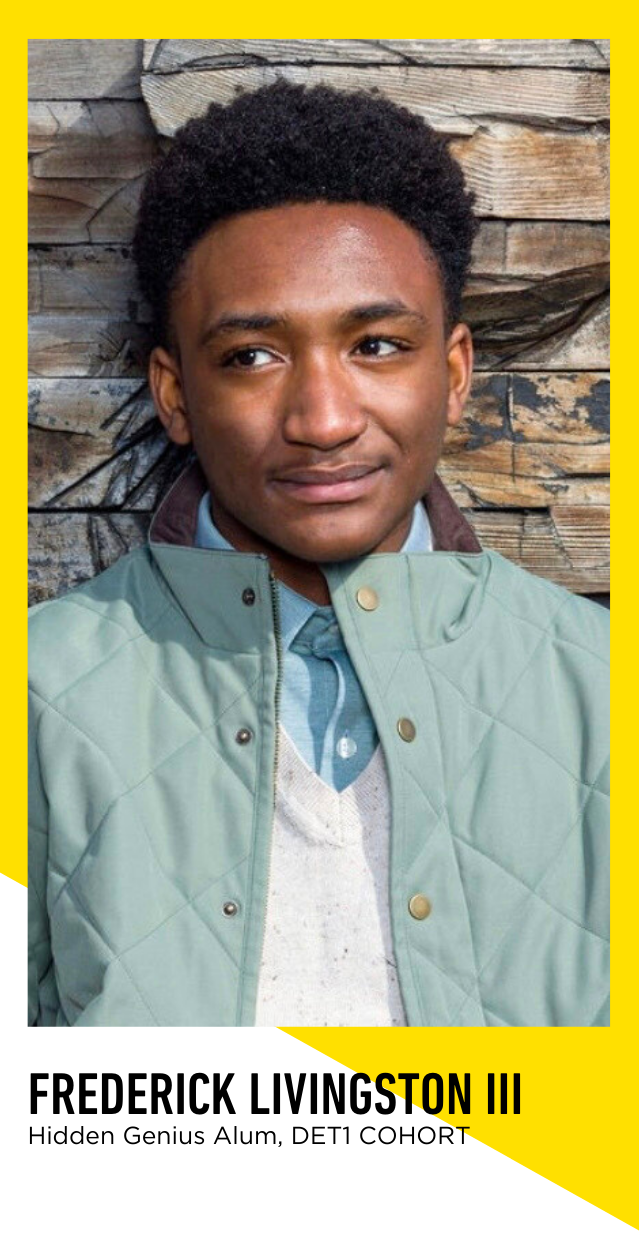 m. Apparently, she followed Mr. [William] Malcolm (Detroit Site Director) on social media because they briefly crossed paths in college. Because of this, she learned about The Hidden Genius Project and later mentioned it to me. I went online, did some research, and the rest is history.
What was your experience in the program like?
My experience was hands-on, challenging, and supportive. I enjoyed the way the program balanced leadership and technology into real projects rather than just lessons. The best part, however, was the environment where we pushed each other, helped each other, and learned how to think beyond the basics. My highlights were collaborating with my cohort and finding the communication skills I didn’t know I had.
One challenge was learning how to step into leadership without second-guessing myself. In the beginning, I didn’t always trust my voice, especially in group settings. Over time, with guidance, I learned how to speak with responsibility and confidence. As they say, death and life are in the power of your tongue. Another challenge was balancing the program with school and life, as well as attendance, because I lived a considerable distance from programming, but my family and Ms. Miracle were always supportive and helped whenever they could, which alleviated this problem a considerable amount.
Describe the final project you created during your time in the Immersion Program.
My final project was a zombie game. The user in this game flew a plane and was able to drop bombs on the zombies with the goal of eliminating all of them. Despite me being horrible at playing my own game, it was a reflection of what the program taught. How to take an idea, understand its purpose, and turn it into something real. It pushed me to think like a builder and a listener at the same time.
How is The Hidden Genius Project different from other mentorship or training experiences that you have been involved in?
The Hidden Genius Project is different because it supports the whole person, not just the skillset. The program builds community, confidence, and a sense of belonging alongside technical skill. It’s rare to find a space where people take the time to understand you culturally and academically at the same time. For example, this past summer I participated in a program that focused on nanotechnology at the University of Michigan in Ann Arbor, and it was very cool. We got to build solar panels, among other things, and were even able to go into the cleanroom, which is something many people, no matter their level of education, will never be able to do. Yet it was missing something, and that was the ability to connect with people based on their different cultures. On a day-to-day basis, The Hidden Genius Project felt intentional in a way very few academic spaces do. Mornings often began with check-ins that centered on how we were doing as people before jumping into technical work. From there, we would dive into hands-on learning, whether it be coding, entrepreneurship, or design thinking. Equally important was the sense of community that developed throughout the program. Whether it was working through challenges in groups, having open conversations about identity and leadership, or simply laughing during breaks, there was a shared understanding that everyone belonged in the space.
What was the most important thing you gained on a personal level from participating in The Hidden Genius Project?
Because of The Hidden Genius Project, I learned important leadership and mentorship skills that I value deeply. With leadership, I learned how to guide others and communicate more clearly. Tying leadership into mentorship, I now take the skills that others taught me and use them to support others. But on a personal level, the most important thing I gained from The Hidden Genius Project was an understanding of systems. Not just technical systems but invisible ones that shape how people are seen, heard, and valued. These systems aren’t always fair. I learned to recognize how these systems affect communities and individuals, even myself. But I also learned how to navigate them and have been given the ability to see how I can change them. The Hidden Genius Project is one of many reasons I chose my major in Biomedical Engineering. I haven’t picked my school yet, but I know that no matter where I go, the satisfaction of building functional systems here has allowed me to think about all the other ones I can build. It has inspired me to think about how I can heal what’s broken, reimagine what’s possible, and disrupt what was never just.
How do you think your path might have been different if you hadn’t participated in The Hidden Genius Project?
Without the Immersion Program, I don’t think I would have the same clarity around my goals. The program has given me opportunities to explore experiences I may not have pursued otherwise. Before, I might have hesitated to step into leadership roles or questioned whether I belonged in spaces I now occupy, especially in engineering and technology, where most of my peers don’t look like me.
Prior to the Intensive Immersion Program, I was also quieter. I also had never really been in rooms with people who looked like me. Growing up, my high school environment was not predominantly Black, which often meant navigating spaces where I felt hyper-aware of being different. While I learned how to adapt and succeed academically, I rarely had the opportunity to fully show up as myself without explanation or adjustment. That experience shaped me to be observant and reserved, especially in rooms where I did not see many reflections of my own identity. Now, with the experience of being surrounded by other Black young men who were equally curious, driven, and talented, I was able to let my guard down and step forward with confidence. I think I carry myself with more intention and self-awareness. I understand my strengths and am willing to bet on myself.
In what ways have you remained involved with The Hidden Genius Project since completing the 15-month Intensive Immersion program?
I’ve stayed involved with the program by becoming a Youth Care Coordinator (YCC). I like helping support the newer Geniuses academically and emotionally. Doing this allows me to assist with community events and workshops, all while being a younger mentor in the space that the Geniuses can rely on. I think of it as my way of giving back.
The staff has continued to support me academically, and they regularly check in on how I’m doing. Sometimes, if I am having trouble in my CyberSecurity class or need to study for one of my Cyber Certifications, I reach out to our Innovation Educator Cam [Cameron Warner], who is always willing to help me. Additionally, Mr. Joe [Joseph Cunningham], our new Alumni Engagement Coordinator, has been a Godsend because this is the time when I need the most guidance. When I was trying to select colleges to apply to, having a peer who has gone through the same things is nice since I can always pick his mind.
If you could talk to yourself just before you applied, what is one thing you would say?
I would say just enjoy the ride. I wouldn’t try to change or give myself any hints about what to do next, even though I regret some of the decisions I’ve made. I think everything worked out this way for a reason, and I wouldn’t change it; it has made me who I am.
What words of encouragement do you have for future Geniuses?
Don’t go where the path may lead, but instead consider going where there is no path and leave a trail. It always seems impossible until it’s done, so why not try? The people who are crazy enough to think they can change the world are the ones who do; so go be crazy, Geniuses.
Since 2012, nearly 11,400 students have revealed their genius through our Immersion, Catalyst, and Community Partner Programs, and so many more are waiting to shine.
HELP NEW GENIUSES STEP INTO THE SPOTLIGHT.
Click HERE to make a donation to The Hidden Genius Project.